
The Prosperity Illusion
For decades, Israeli—and Western policymakers as well—clung to the belief that improving Palestinian economic conditions would restrain terrorism. The logic was simple: prosperity would temper radicalism. This belief led Israel to accept Qatari cash infusions into Gaza, imagining that financial stability would pacify Hamas.
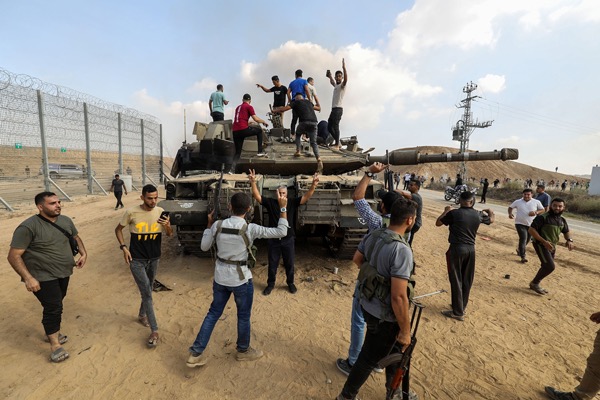
The collapse of this misconception—along with others—came violently on October 7. Much of the world now demands the establishment of a Palestinian state as a kind of reward for Hamas' atrocity. And so we confront a chilling conclusion: the forces that failed to destroy the Jews in Auschwitz now pursue the same goal "from the river to the sea."
But Israel should have learned this lesson long ago. 38 years of non-stop Palestinian terrorism has demonstrated the total fallacy of this doctrine put forth by our perpetual do-good thinkers who lived in a make-believe bubble. Reality had long ago proven the murderous idiocy of this theory. The First Intifada erupted in 1987 at a time when tens of thousands of Palestinians were working inside Israel. And the October 2023 massacre occurred precisely when Gaza was flourishing—Qatari money flowing, construction booming, workers crossing daily into Israel, and Hamas seemingly "fat and deterred."
The October 7 massacre did not merely kill Israelis; it killed the Oslo paradigm and a host of long-held illusions. Anyone who insists on the "right of return," on "Palestine from the river to the sea," and on Jerusalem as its capital is not genuinely pursuing peace. And in this conflict, as history repeatedly teaches, the side that barricades itself becomes the side attacked; the side that takes the initiative becomes the side that survives.
Democracy Was Not a Panacea: Like in 1933, the Free Elections in 2006 Led to a Fascist Government
In 2006, Israel and the United States embarked on what, in hindsight, was a perilous experiment: Palestinian elections. To Western architects, this was democratization. To many in the region, it was wishful thinking. As another Arab proverb warns: "A dog's tail will remain crooked even if you clamp it in a vise for forty years." In other words, you cannot straighten what is fundamentally bent.
The election results proved devastating. Palestinians freely chose Hamas. The Palestinian Authority refused to accept the outcome. Gaza descended into brutal internecine warfare. Hamas militants hurled Fatah members off rooftops and hung bodies in public squares. The fantasy of Western-style democracy, transplanted into a blood-soaked tribal environment, collapsed grotesquely. Hamas carried out hundreds of fatal attacks in Israel as it executed thousands of Palestinian dissidents, gays, Christians and anyone that didn't accept their Islamist rule whom they simply called "collaborators."
Yet despite this cold hard reality, the subsequent 15 years of Hamas rule reinforced Israel's misconception that Hamas' control of Gaza could be strategically useful. The rivalry between Hamas and Fatah helped Israel stall international efforts to impose a Palestinian state. In that spirit, Israel tolerated Hamas rule in Gaza because it created a divided Palestinian polity and helped deflect international pressure to establish a Palestinian state. It was an alliance of cynical utility disguised as strategy.
The West Rewards the Perpetrators of the October 7th Massacre
But this calculation depended on Hamas remaining contained in its tunnels. After October 7, that façade evaporated. Paradoxically, the massacre prompted several governments to demand a Palestinian state not as a repudiation of terror but as a concession to it.
Thus the grim argument: the same forces that once failed to annihilate the Jews in Europe now pursue their goal between the Jordan River and the Mediterranean Sea, with or without the blessing of Israel's High Court.
Should the Palestinian Authority attempt to reenter Gaza, bloodshed will follow. The collapse of Hamas will produce chaos—settling of scores among its operatives, retaliation from their rivals, and desperate efforts to retrieve the dead from the rubble and begin rebuilding.
The Day After Gaza
In the meantime, Israel's task is clear: destroy the terrorist networks entrenched beneath Rafah, and abandon the illusion that global "marketing" of harsh legal actions against Israeli soldiers—such as the Sde Teiman controversy—will earn international favor. The world does not reward self-inflicted scrutiny.
There are no subcontractors in the fight against terror. Yasser Arafat once acted as one, as the Karine-A weapons smuggling affair demonstrated. UNIFIL, the UN peacekeeping force in Lebanon, enabled Hezbollah's consolidation. UNRWA, the UN's Palestinian aid agency, became entangled with Hamas operatives, its facilities used for storage, recruitment, and indoctrination. Outsourcing security has always ended in disaster.
In the final analysis, it is insane to believe that a new Arab dominated "peace keeping force" or any multinational force will do anything to stop Hamas. There is only one institution capable of defending Israel: the Israel Defense Forces.
 IPT Senior Fellow Reuven Berko holds a Ph.D. in Middle East studies, specializing in Arab and Islamic Affairs. He served as the Adviser on Arab Affairs to the Jerusalem district police. Berko is a frequent commentator on major Arabic satellite programs and an analyst for the Arabic Affairs program on Israeli TV. He writes for a broad range of Israeli and Arab newspapers and is considered one of Israel's top experts on Arab affairs.
Articles by the IPT may be re-published as long as full attribution and a link back to the original article is provided. |