
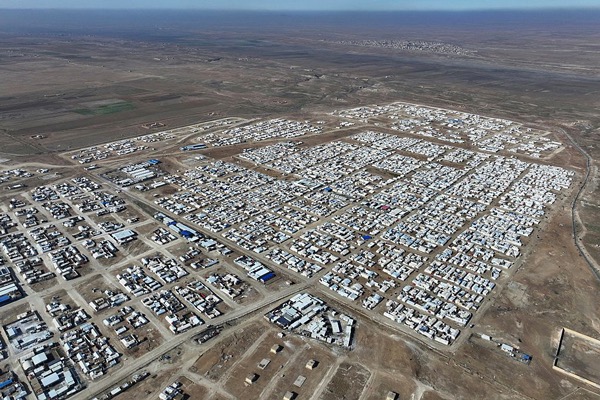
When The Wall Street Journal reported Friday that up to 20,000 ISIS-affiliated detainees had disappeared from Syria's al-Hol camp, it wasn't describing a routine breach. It was describing the possible unraveling of one of the most consequential counterterrorism containment systems built after the fall of the Islamic State's territorial caliphate in 2019.
I've been conducting interviews over the past ten months with various communities in Syria. And in the past two weeks—based on interviews with U.S. and European intelligence officials, military liaisons, and observers inside Syria—I confirmed that between 15,000 and 20,000 individuals formerly held at al-Hol are no longer under centralized control. In counterterrorism terms, that is not a leak; it is a structural rupture.
The Al-Hol Detention Camp—The Largest Terrorist Camp in the World.
Al-Hol concentrated a dangerous ecosystem—families, facilitators, recruiters, and children raised inside extremist ideology—into one place that could be monitored. The camp was volatile and often inhumane, but containment prevented dispersion into fragile terrain where ISIS cells still operate.
Several sources described the same unsettling dynamic: nothing looked like a single dramatic breach. There was erosion—smaller guard details, longer blind spots, routines that stopped being routine. And the new "guards"—ie the jihadists in Syria's new army? Some of them were observed yelling encouragement to the "escaped" detainees, even giving out candies to the children of ISIS wives.
By the time US officials began asking for numbers, the question was no longer how many had slipped out. It was whether anyone still believed there was a coherent perimeter at all. I spoke to a longtime acquaintance from the Pentagon who said he could not give details of what happened other than to say, "This was a self-inflicted wound that I fear we will be paying for in lives and cost for many years to come. I am afraid we just helped midwife a new terrorist state that will far eclipse the one run by Assad."
The Camp That Held the Aftermath
To understand why this matters, start with what al-Hol actually was. It wasn't simply a humanitarian holding site. For years it functioned as the largest centralized reservoir of ISIS family networks in the world: wives of fighters, logisticians, financiers, ideological enforcers, and thousands of children raised inside a movement designed to outlive battlefield defeat.
Outside the wire were Kurdish guards who had buried roughly 9,000 of their own in the campaign to dismantle ISIS's territorial rule. Americans fought alongside the Kurdish-led Syrian Democratic Forces (SDF) in the war that broke the caliphate's last strongholds. After 2019, the battlefield victory required a second, quieter mission: detention and surveillance, day after day, to prevent ISIS networks from regrouping.
Containment rarely makes headlines. It looks like biometric checks, patrol rosters, and nights when nothing happens. Yet it is precisely those uneventful nights that prevent the diffusion of ideological networks into zones where they can rebuild. U.S. officials understood privately that without sustained detention, the "victory" over ISIS would erode.
The Transfer and the Breakdown
The breakdown began after control of the camp shifted from SDF supervision to Syrian government forces. The transfer was framed publicly as "stabilization" and a restoration of "central sovereignty." In truth those were the same words used to justify Syrian President al-Sharaa's murderous assault last year through January of this year on every major Syrian religious minority and ethnic group. It is and has been a blatant attempt to establish Islamic supremacy in Syria and force minorities to adhere to a Sharia state.
Within days, monitors reported thinning patrol rotations and weakened perimeter enforcement. Population counts dropped sharply. Observers described not a trickle of escapes, but a rapid emptying of sectors—family clusters disappearing in ways that suggested coordination, permissiveness, or both.
I have been in contact with a senior SDF commander for the past 3 months. He predicted 2 things to me: the first was that the Syrian Army would launch an ethnic cleansing campaign against the Kurds as the regime had launched against the Alawites, Druze and Christians. That came true in January. The second thing he predicted was a mass escape—or as he called it a "mass release" of ISIS terrorists from jails once the regime evicted the SDF. That happened this past week. "All of his was guaranteed to happen. We issued plenty of warnings to no avail."
For nearly two weeks, Syrian officials publicly blamed Kurdish "mismanagement," pointing to old smuggling routes and imperfect records. And certain media like the Washington Post and Associated Press became a jihadist echo chamber. Their reporting amounted to issuing Syrian press releases. But intelligence officials I interviewed said the nearly all of the significant waves of departures occurred after Syrian forces arrived on the scene. They didn't "assume control-as the Syrian government claimed was their mission; they lost control deliberately.
Syrian officials' public messaging followed a familiar arc: assurances of control, then claims that any problems were inherited, and only later a partial acknowledgment that escapes were extensive and continued even as forces tried to impose order.
In counterterrorism, time is the decisive variable. The earlier a dispersal is acknowledged, the earlier a response can be mobilized—interdiction, tracking, checkpoints, coordination with neighbors. Delay does not just obscure blame; it expands the operational space available to those leaving.
In an interview with a US military official who served as part of the liaison team to the SDF, he told me, "I watched this catastrophe happening in slow motion... each day worse than the last."
A Syrian government representative acknowledged in a tv interview in the last 48 hours that the camp had been "largely emptied by escapes" while state forces were present. The admission did not explain whether the collapse resulted from incompetence, corruption, ideological sympathy, or deliberate permissiveness. It did, however, confirm the core fact earlier statements obscured: the exodus happened on the government's watch.
Why the Number Matters: The New ISIS Threat to the U.S.
If the scale feels abstract, consider why 20,000 changes the equation. The difference between several hundred escapees and 20,000 is not incremental; it is strategic. ISIS regeneration does not begin with territory. It begins with networks—kinship ties, ideological continuity, and the quiet rebuilding of operational capacity.
In December, a small ISIS-linked cell killed three American service members in Syria. That attack required only a handful of operatives. It is a reminder that ISIS remains lethal without holding land, and that a relatively small network can still kill Americans.
Now multiply the operational space by the dispersal of thousands embedded in extremist ecosystems. Even if only a fraction reconstitute into organized cells, the probability of coordinated violence rises. European security services face renewed radicalization risk among adolescents raised inside ISIS family networks. The United States must assume heightened force-protection burdens and renewed external plotting risk.
Reintegration Without Infrastructure
As the scope of the dispersal became clearer, Syrian officials began speaking of "reintegration" for Syrian-born ISIS affiliates. In theory, reintegration can work—but only when it is built on infrastructure: structured deradicalization, psychological intervention, religious counter-ideology, judicial oversight, and sustained monitoring.
Even in European countries with significant resources, recidivism remains a stubborn reality. I spoke to a senior European counterterrorism official with two decades of experience attempting to rehabilitate convicted jihadists described the gap between bureaucratic language and operational reality as the gap between prevention and the next attack. He told me, "The rate of recidivism among these terrorists who undergo 're-education' is about 70%... signing a piece of paper changes nothing."
Without guardrails, "reintegration" risks functioning as dispersal under another name: a pipeline from detention into the same unstable terrain where ISIS networks thrive. Announcing reintegration in the middle of a mass dispersal, without demonstrating a credible apparatus, is not reassurance. It is a warning.
The Future is Bleak for Syria's Minorities
The collapse of al-Hol's containment is unfolding against a broader backdrop of sectarian volatility. Over the past ten months, I have conducted more than 150 interviews with members of Syria's religious and ethnic minorities—Christians, Druze, Yazidis, Alawites, and others—and speaking with survivors of massacres, bombings, and executions carried out by forces aligned with the al‑Sharaa government and allied Sunni jihadist militias.
Across interviews, a consistent pattern emerges: intimidation, selective enforcement, violence, and promised "independent investigations" that never materialize. Survivors describe raids, disappearances, execution-style killings, and forced displacement—often with the unnerving calm of people who no longer expect accountability. The mass murder reminded vividly of the slaughter of Israelis on October 7.
Executing Druze for Sport
In July last year, between 2,000 and 3,000 Druze were killed over several days, according to community sources. I have previously reported that FBI investigation was initiated into the execution of an American Druze, Hussam Soraya—killed alongside his brothers, father, uncles and cousins-- forces allied under al‑Sharaa's authority. Yet that criminal inquiry has gone nowhere despite eyewitness testimonies AND a video of the execution filmed by the killers themselves. Druze leaders collecting evidence against perpetrators report threats of death if they persist. One Druze is seeking a visa to come to the US to testify. But he cannot get a visa. I shudder to think what will happen to him
Impunity as a Signal
After each horrific episode, al‑Sharaa has vowed independent investigations. Yet none occurred. When investigations are promised and not conducted, victims learn that survival depends on silence, and perpetrators learn that violence carries little cost. In such an environment, impunity becomes a signal.
Most outrageously, Druze community reporting on X has alleged that the main perpetrator of the July massacre—Qusay al‑Shammari—was pardoned. According to that reporting, he was reportedly detained after the massacre and then freed in recent days as part of broader pardons issued by al‑Sharaa to dozens of jihadists accused of murder. Within Druze communities the claim has hardened into a symbol of state-sanctioned absolution.
If accurate, the message is devastating. If left unaddressed, the perception alone will deepen sectarian fear and accelerate community flight—exactly the kind of rupture extremist movements exploit.
A Fractured Firewall: What Will the West Do?
Taken together, the dispersal from al-Hol and the pattern of uninvestigated minority violence point toward a common risk: the erosion of institutional constraints in a landscape already saturated with armed ideology. Mass atrocity does not arrive without warning signs. It emerges through escalating impunity, weakened enforcement, and emboldened armed actors.
Containment required years of sacrifice measured in American and Kurdish lives. Its unraveling occurred in days. The question now is not whether the dispersal occurred—that is documented by intelligence assessments, eyewitness observation, and official admission. The question is whether policymakers treat this as a manageable headline or as a strategic inflection point.
Terrorist Ecosystems
When extremist ecosystems scatter across fragile terrain, the consequences rarely remain contained. The people who will pay the price will not be the officials who issued the first statements. They will be the civilians in Syria's vulnerable communities, the soldiers deployed to contain the next wave, and the citizens in the region and the West who discover, too late, that "after the caliphate" was never the same as "after ISIS."
Its time to stop this madness of legitimizing al-Sharra's regime. Otherwise, the lesson of the last decade will repeat: ISIS is patient, and it only needs time and space.
 Steven Emerson is executive director of the Investigative Project on Terrorism, which tracks radical Islamist networks in the West. He is the author of eight books and producer of multiple award-winning documentaries, including "Jihad in America: The Grand Deception" which is the only comprehensive exposé of the Muslim Brotherhood's covert infrastructure in the United States.
Copyright © 2026. Investigative Project on Terrorism. All rights reserved.
Articles by the IPT may be re-published as long as full attribution and a link back to the original article is provided. |