
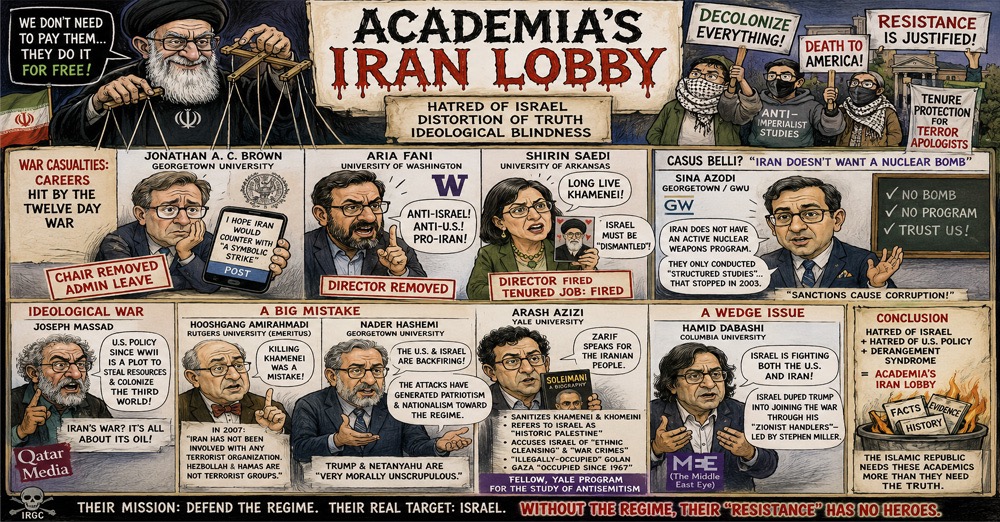
In 2021, after the Biden Department of Justice indicted Boston University professor Kaveh Afrasiabi for acting as an unregistered agent of the Iranian government, alleging that he was paid hundreds of thousands of dollars "to create and disseminate information favorable to the Iranian government," I wrote that it was wasted money since so many academics in the U.S. are willing to promote the Islamic Republic for free.
In the years since, and in spite of Afrasiabi's suspicious (autopen?) pardon, more pro-Islamic Republic academics have emerged, so many in fact that calling them "Academia's Iran's Lobby" is not even slightly hyperbolic.
War Casualties
While the joint U.S.-Israel attacks against Iran in 2025 and 2026 have killed untold numbers of IRGC commanders and other regime leaders, as a bonus, they have also exposed some of the most egregious pro-Iran academics to the general public, deservedly injuring and even killing some academic careers.
Jonathan A. C. Brown of Georgetown University was a casualty of the Twelve Day War in June 2025, when he posted on social media that he hoped that Iran would retaliate with "a symbolic strike" on an American base in the region. The university was so embarrassed by Brown that it removed him as chair of the Arabic and Islamic studies and placed him on administrative leave while it investigated. The investigation is ongoing.
Next came Aria Fani, an associate professor of Middle Eastern languages and cultures at the University of Washington. His anti-Israel, anti-U.S., pro-Iran musings cost him his job as director of the Center for Middle East Studies.
Fani defended himself by claiming that he was fired because he is Iranian and that he was merely expressing his free speech. However, he admits that he was told that he had "used the [Middle East Center's] Listserv improperly" in a March 18 email in which he called Zionism a "cancerous, a potentially fatal outgrowth in our planetary body."
Most recently, Shirin Saedi first lost her job as the director of the King Fahd Center for Middle East Studies at the University of Arkansas in December 2025, because of her praise of Iran's now dead Supreme Leader and calling for Israel to be "dismantled." Like Fani, Saedi had expressed her personal views on university letterhead in a letter of support for a convicted Iranian war criminal. After repeated warnings, she was fired from her tenured position at the university in April. Dean Brian Raines wrote that her "repeated statement that Israel ... must be 'dismantled' ... undermines any perception of our program as a scholarly and objective source of research and information rather than indoctrination."
Casus Belli?
Before examining how academic criticism of the war against Iran is being carried out, it is worth noting that many academics deny that there is even a reason to fear an Iranian nuclear program.
Among those who insist that Iran is not trying to build a nuclear bomb is Sina Azodi, an assistant professor of Middle East politics at George Washington University's Elliot School of International Affairs.
Videos of Azodi, who is also director of the Master's program in Middle East studies at Georgetown, downplaying the Islamic Republic's nuclear ambitions constitute the bulk of his internet presence where he is treated as an expert on everything Iran, from its history to its moment-by-moment thinking.
Since completing his Ph.D. in 2023, Azodi has kept busy warning every talking head who needed an Iran "expert" to interview that "sanctions increase corruption in Iran" and denying the existence of Iran's nuclear program.
In an interview with Bloomberg, the unctuous academic unconvincingly denies the Islamic Republic's nuclear ambitions through a combination of diplospeak and academic obfuscation. He argues that "Iran does not have an active nuclear weapons program" and supports his argument by claiming that it conducted only "structured studies on issues directly related to nuclear weapons, but that stopped in 2003."
An Ideological War
Some academics, driven by "post-colonial" ideology and determined to "decolonize" the world, see the war as yet another U.S. empire-building campaign, farmed out to the "settler-colonial state" of Israel.
Joseph Massad, one of the first academics to cheer on Hamas on October 7, predictably has been very supportive of the Islamic Republic. He has taken the opportunity of war to lecture his readers in Qatari media about the evils of American foreign policy, revealing his profound ignorance. Showing his ineptitude as an historian, Massad views all U.S. policy from World War II to the 1990s as a massive plot to steal resources from third world nations and colonize the people who live there. While entirely ignoring the true driving force of those years, the Cold War, Massad believes that the current war against Iran is also about stealing its oil rather than preventing it from making nuclear weapons and destroying its ballistic missiles.
A Big Mistake
Quite a few members of Iran's academic lobby are busy arguing that attacking Iran was an error. Hooshgang Amirahmadi, the former director of Rutgers University's Center for Middle Eastern Studies and founder of the American Iranian Council, now enjoying his emeritus status, weighed in by announcing that killing Khamenei was a mistake. Of course he would think so. In 2007 he said that "Iran has not been involved with any terrorist organization. Neither Hezbollah, nor Hamas are terrorist organizations."
Nader Hashemi, associate professor of Middle East and Islamic politics and director of the Prince Alwaleed bin Talal Center for Muslim-Christian Understanding at Georgetown University, the man who once speculated that Israel's Mossad was behind Hadi Matar's attempted assassination of novelist Salman Rushdie, is always ready to blame Israel and the U.S. for Iran's problems. He recently told a Georgetown publication that the war against Iran was backfiring and making the regime more popular. "The U.S. and Israeli attacks have generated a rising sense of patriotism and nationalism toward the country," he argued, adding that "What has also helped is the fact that both Trump and Netanyahu are very morally unscrupulous politicians."
At a recent Yale University on-campus event, "The War on Iran: A Roundtable Discussion," covered by a student who wrote about it for Algemeiner, Arash Azizi, an Iranian-American academic "said that former Iranian Foreign Minister Zarif speaks on behalf of the Iranian people."
This is consistent with the pro-regime biography of Qassem Soleimani that Azizi published as a graduate student at New York University in 2020, sanitizing Khomeini and Khamenei, and canonizing Soleimani.
Remarkably, Azizi is now a post-doctorate fellow at Yale's Program for the Study of Antisemitism, where blind and evidence-free criticism of Israel apparently gets one in the door. His book refers to Israel as "historic Palestine" (p. 72), accuses it of "ethnic cleansing" (p. 184) and "war crimes" (p. 202), refers to "the illegally-occupied Golan Heights" (p. 196), and insisted in 2020 that Gaza had been "occupied by Israel since [1967]" (p. 184).
A Wedge Issue
Some see the war in Iran as a way to stir conflict between Trump and his supporters, portraying it as a betrayal of the president's "no more forever wars" promise. Others, like Hamid Debashi, the Hagop Kevorkian professor of Iranian studies and comparative literature at Columbia University, see in the war an opportunity to drive a wedge between the U.S. and Israel.
Dabashi wrote on April 8, 2026, in the Emir of Qatar's "journal," The Middle East Eye, that the U.S. and Israel are not fighting Iran, but rather that Israel is fighting both the U.S. and Iran. Dabashi follows the copy-and-paste journalists here, claiming that "Israel duped Trump into joining" the war through the president's "Zionist handlers – led by Stephen Miller."
Conclusion
What drives the members of Academia's Iran lobby is equal parts hatred of Israel and U.S. foreign policy. Throw in a measure of Netanyahu and Trump Derangement Syndrome, and the combination becomes an academic Iran lobby that the regime couldn't purchase even if it was selling millions of barrels of oil every day.
Most members of academia's Iran lobby don't really care about Iran or the Iranian people. Their main concern is the Islamic Republic's status as the leading state sponsor of terrorism, especially terrorism targeting Israel. If the Islamic Republic falls, Hamas, Hezbollah and the Houthis will likely follow.
The Islamic Republic provides ideological sustenance to its academic lobby. Without its actual "resistance," the academic pretend "resistance" would have no role models.
 Chief IPT Political Correspondent A.J. Caschetta is a principal lecturer at the Rochester Institute of Technology and a fellow at Campus Watch, a project of the Middle East Forum where he is also a Milstein fellow.
Copyright © 2026. Investigative Project on Terrorism. All rights reserved.
Articles by the IPT may be re-published as long as full attribution and a link back to the original article is provided. |