
The War the World Got Wrong
A new book reveals the chaos and infighting inside the Israeli government and exposes how the media and human rights groups rushed to convict Israel of genocide and famine, and why the record still has not been corrected
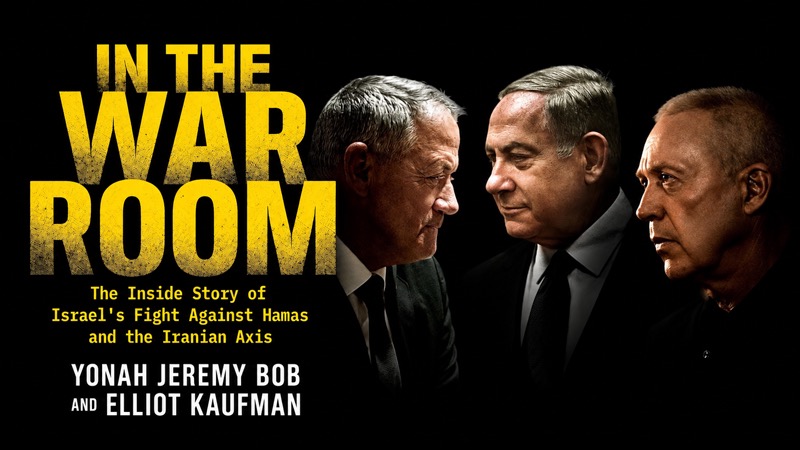
Three years after Hamas sent its death squads across the border on October 7, 2023, we finally have a book that tells the full story of the war that followed. It is a mesmerizing book that kept me fascinated by the unmatched detail in the authors' meticulous reporting, which provides both the ground-level view and the 30,000-foot view.
In the War Room: The Inside Story of Israel's Fight Against Hamas and the Iranian Axis, by Yonah Jeremy Bob of The Jerusalem Post and Elliot Kaufman of the Wall Street Journal editorial board, is the best reporting yet published on that war. Built on two years of interviews with Benjamin Netanyahu, Yoav Gallant, Benny Gantz, their generals and spymasters, and the American officials who tried to restrain them, it is a monumental work of enterprise journalism.
Required Reading
This book is essential reading for the public and specialist alike. It provides granular detail, much of it never revealed before, of what was happening behind closed doors. And it provides a much-needed corrective to the often distorted and factually incorrect views propagated by the day-to-day mainstream media.
Policymakers should read it to understand how wars against terrorist armies embedded among civilians are fought. And journalists should read it most of all. It confronts them with the evidence of their own malpractice: how quickly and uncritically so many of them became mouthpieces for Hamas.
A Verdict Before the Bodies Were Counted
As the authors show, a guilty verdict against Israel was delivered before its ground war had even begun, against an enemy that had just committed one of the most savage atrocities of the last hundred years. Israel was being branded guilty of genocide while its forensic teams were still working to identify the remains of babies and parents who had been mutilated, raped and burned. On October 7 itself, Amnesty International headlined its statement "Civilians on Both Sides Paying the Price of Unprecedented Escalation."
Within two weeks it was alleging "Damning Evidence of War Crimes" by Israel. It later accused Israel of genocide.
On October 13, before Israel's ground invasion had begun, a professor of genocide studies "had somehow already declared Israel's counterattack 'a textbook case of genocide.'" The human rights groups, the authors write, portrayed Israel's war effort "as pure malevolence."
October 17: The Day the Coverage Broke
"Many on the radical Left were ready to condemn Israel on October 7 and 8," the authors write. "But it was on October 17 that biased coverage of Israel went out of control."
That day, the authors recount, Hamas announced that an Israeli airstrike had killed at least five hundred people at al-Ahli Arab Hospital in Gaza City. The New York Times put the claim in its headline, and the rest of the world followed. The BBC said it was "hard to see what else this could be."
It was a misfired Palestinian rocket that struck the hospital's parking lot. U.S. intelligence concluded with high confidence that Israel was not responsible, and Israel identified the rocket as Islamic Jihad's.
"The damage was done," the authors write. "The October 7 attack was only ten days old, but a new narrative was already forming."
Rafah: The Catastrophe That Never Came
That narrative never let go, and the genocide charge reached its peak over Rafah. For months the Biden administration insisted Israel had "no credible plan" to move the city's civilians. Evacuation would take four months or more, officials said, and thousands, perhaps twenty thousand by one estimate, would die.
Vice President Kamala Harris declared there was "nowhere for those folks to go." The European Union's foreign policy chief asked whether they should go "to the moon."
"A catastrophe that never arrived."
The Israel Defense Forces, the authors report, moved roughly 950,000 people out of harm's way in two weeks. The "All eyes on Rafah" campaign, the authors note, went viral for "a catastrophe that never arrived." South Africa pressed its genocide case at the International Court of Justice anyway.
The Famine That Kept Not Arriving
The famine charge followed the same arc. UN agencies and NGOs "repeatedly projected" mass famine in the war's first year, and it "did not materialize."
The UN-affiliated famine monitor, the IPC, forecast famine "anytime between mid-March and May 2024." When it didn't come, "no one was called to account."
When the IPC finally declared famine in August 2025, the authors report, "a full-fledged famine failed to materialize and there was strong evidence that the IPC had cherry-picked its data."
"No one was called to account."
The Pictures Behind the Pictures
Photos of emaciated children circled the globe. Those children were "often suffering from preexisting muscular disorders," the authors write, "though much of the media coverage left that part out."
And in just two months of 2025, the authors report, citing an analysis by Britain's Jewish Chronicle, the BBC ran thirty-three separate headlines promoting claims that Israeli forces had killed civilians seeking food at the new American-backed aid sites.
The Prosecutor's Timing
The International Criminal Court is the book's starkest case study. In May 2024, prosecutor Karim Khan announced on CNN that he was seeking arrest warrants for Netanyahu and Gallant alongside Hamas leaders Yahya Sinwar, Mohammed Deif and Ismail Haniyeh.
The authors call it "precisely the false equivalence that Israelis found most offensive." Khan accused Israel of starving Gaza after, the authors note, it had let in more than 28,000 aid trucks.
He made his announcement, the authors report, just two and a half weeks after being confronted with sexual misconduct allegations by a subordinate.
The Silence at the UN
Through it all, the UN General Assembly did not condemn the October 7 massacre until September 2025. The Security Council, the authors note, never condemned it at all.
Hamas Didn't Need to Win
None of this happened by accident. The book's sharpest insight is that Hamas never needed to win on the battlefield.
"It just needed to hide and hold onto the Israeli hostages long enough for Israel to lose focus and momentum or face more international pressure than it could bear."
It built hundreds of miles of tunnels for its fighters and none for civilians. It put command posts under hospitals and schools; Bob saw the evidence himself at Shifa Hospital. It "used violence to stop its own civilians from evacuating."
Who Controlled the Numbers
Hamas stole fuel and taxed food aid. Above all, it controlled the numbers.
Its Health Ministry never distinguished fighters from civilians. It never corrected its false al-Ahli figure. And it claimed that 70 percent of the dead were women and children, a claim the authors say "was not nearly true."
A World That Cooperated
The strategy worked because the world cooperated. In March 2024, Egyptian officials told the Journal, Sinwar hardened his terms, citing Israel's internal divisions and "mounting US pressure on Israel to do more to alleviate the suffering of Gazans."
When Western governments rushed to recognize a Palestinian state in 2025, the authors write, it gave Hamas "an incentive to continue rejecting" ceasefire offers.
The Enemy in Full
Through it all, the book makes plain whom Israel was fighting. Hamas "went on a rampage, slaughtering civilians en masse." Sinwar once told an Israeli prison dentist that sacrificing Palestinian lives was worth it: "Even 100,000 is worth it."
"Even 100,000 is worth it."
Hostages were held in cages. Six young captives were found murdered in a Rafah tunnel, their bodies badly malnourished. Kfir and Ariel Bibas, taken hostage at nine months and four years old, were "brutally murdered," and Hamas made "a macabre show of parading their coffins."
This is the enemy against whom every Israeli decision should have been judged. Too often, it disappeared from the coverage.
You Are in the Room
What makes the book extraordinary is that it puts the reader inside the room where Israel's decisions were made.
On October 11, 2023, Gallant was ready to launch more than a thousand strikes against Hezbollah. Then President Biden told Netanyahu, "Do not do this," and the paragliders the IDF thought it had spotted turned out to be geese.
Two days earlier, Netanyahu had banged the table demanding 5,000 targets instead of 1,500, and the IDF chief, Herzi Halevi, had to be "the adult in the room." Yet Netanyahu, the authors show, dreaded "thousands of dead Israeli soldiers" and had to be pushed into the ground invasion.
"Do It Today!"
On the morning Nasrallah was killed, Halevi and Gallant learned of a last-minute "golden nugget" of intelligence: Nasrallah was talking about moving. When Halevi passed it on, Netanyahu, in New York for the UN General Assembly, banged the table and exclaimed, "do it today!"
Later that morning, Halevi was giving a closed briefing to a small group of Israeli military correspondents, Bob among them, when he stepped out for about twenty minutes. Bob was less than a hundred feet away as Halevi and Gallant held the call with Netanyahu and made the decision to strike that evening.
"Flying Over Fordow Freely"
In June 2025, Halevi's successor as IDF chief of staff, Eyal Zamir, told Vice President JD Vance, "We are already flying over Fordow freely." Two days later, American bombers struck Iran's nuclear sites.
The result, the authors argue, was a generational defeat of the Iranian axis: Hezbollah broken, Hamas's battalions dismantled, Assad gone, Iran's nuclear program set back by years, and all twenty living hostages brought home.
No Cheerleaders
Bob and Kaufman are no cheerleaders. They document the grave mistakes Israel's leaders made in a war unlike any fought before.
Israeli intelligence had Hamas's invasion plan in hand and dismissed it as fantasy. On the morning of October 7, the authors reveal, Netanyahu and Halevi did not speak to each other until roughly four hours into the Hamas invasion.
Barring foreign journalists from Gaza was a "strategic error" that "gave Hamas a near monopoly on reporting." Cutting off all aid in March 2025 was, in the authors' words, "one of Netanyahu's greatest wartime errors," and it handed Israel's accusers a real crisis to exploit.
That candor and the unmatched detail in their meticulous reporting are precisely what give the book its authority. These are reporters, not apologists. When they show how badly the press and the human rights establishment got this war wrong, they do so having told hard truths about Israel too.
The Central Falsehood
The central falsehood of this war, that Israel set out to exterminate or starve a people, was a malicious lie. The authors show how Hamas manufactured it, and how readily it was spread by those who had been eager for years to believe the worst about Israel.
A terrorist army hid behind its own people, supplied the casualty figures and largely controlled what the world saw. A credulous press and a politicized human rights industry repeated its claims, and almost none of them corrected the record when those claims collapsed.
In the War Room should be read by every citizen who wants the truth about this war, by every policymaker who will face the next one, and by every journalist who repeated Hamas's claims without asking where they came from.
 Steven Emerson is an award-winning investigative journalist, documentary filmmaker, and founder and executive director of the Investigative Project on Terrorism (IPT), which maintains one of the world's largest archives on Islamist terrorist networks. He is the author or co-author of eight books on terrorism and national security.
The book's endnotes cite a report by the Investigative Project on Terrorism.
Copyright © 2026. Investigative Project on Terrorism. All rights reserved.
Articles by the IPT may be re-published as long as full attribution and a link back to the original article is provided. |